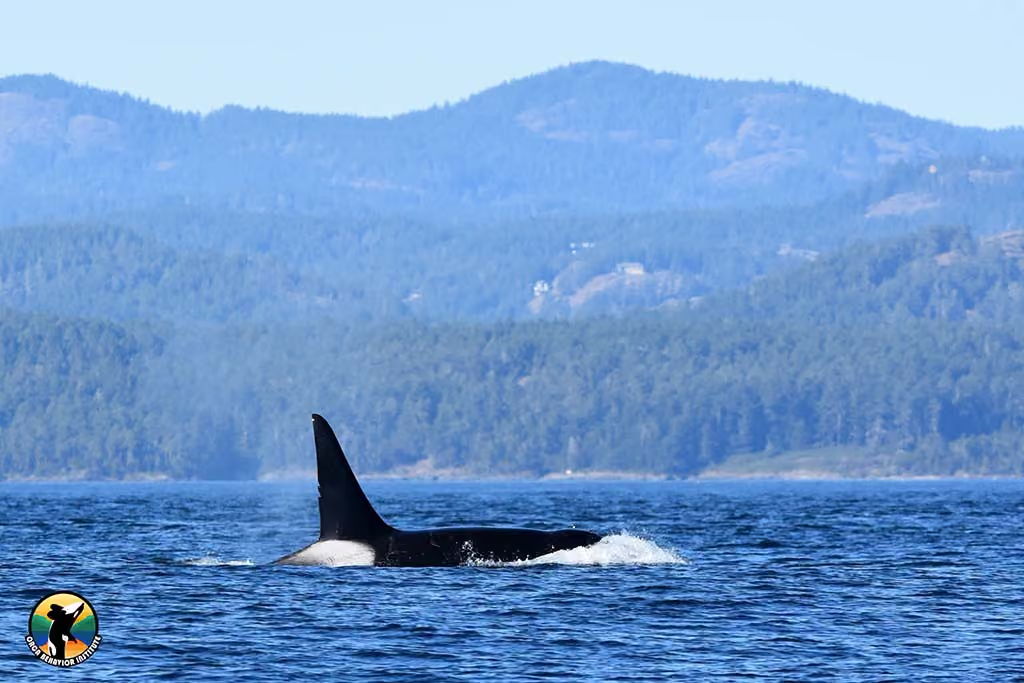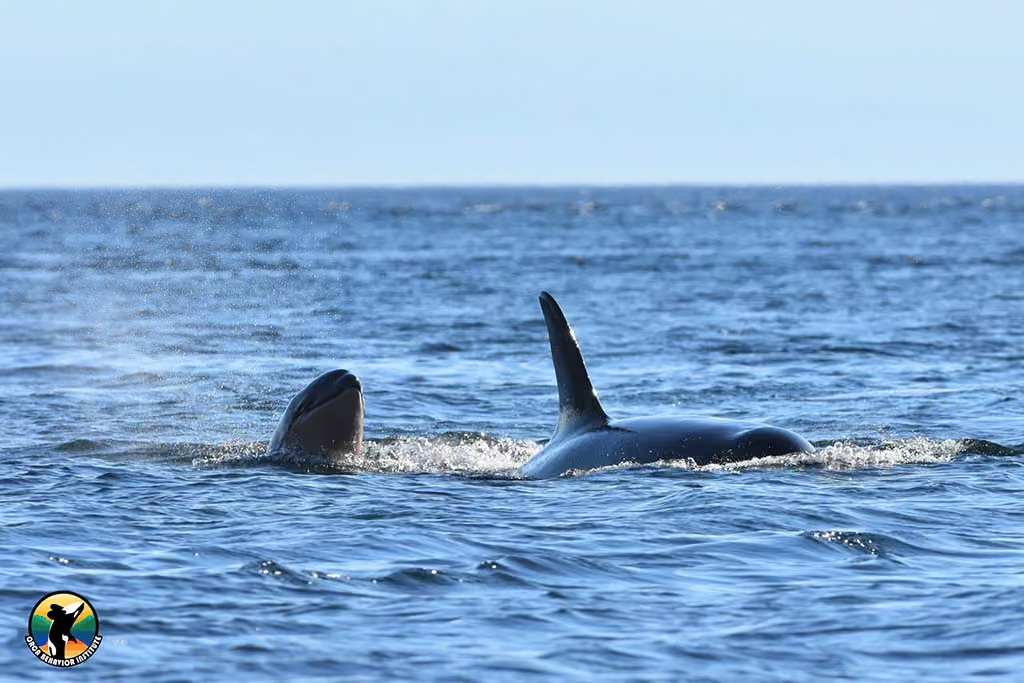
Side-by-side comparison of 2025 orca sightings in the Salish Sea (SRKW vs Bigg's)

Here is our side-by-side comparison of Southern Resident killer whale (left) and Bigg's killer whale (right) sightings throughout the Salish Sea for the entirety of 2025. We define a sighting as a unique group of whales seen on a unique day, and the location of each dot indicates where a group was first reported for that day. On the Bigg's map, the size of the circle indicates the relative group size.
For Southern Resident killer whales, sightings within the Salish Sea were down over 30% compared to 2024 and down 10% compared to the 10-year average. For the six months spanning April to September, for which the central Salish Sea used to be considered their core habitat, it was the second lowest year on record in terms of number of days they were present, with only 2021 having been lower. The months they were here the most were September, March, and April, while they were not here any day of the month in May, June, or August.
Overall, SRKW sightings now vary widely from year to year and are now much less predictable than they used to be. It's hard to draw any conclusions from one year of data, or a comparison between two years, but we believe the primary reason they have altered their patterns is due to shifting availability of their primary prey, Chinook salmon. This has been well documented in the scientific literature in papers published by us and others.
For Bigg's killer whales, it was yet another record year, with 1860 unique sightings confirmed within the Salish Sea. The question is, is their meteoric rise finally starting to level off? Between 2023 and 2024, their presence rose by nearly 30%, something we had seen several times over the last decade. Between 2024 and 2025, however, the increase was less than 2%. It will be extremely interesting to see if 2026 remains in this range, yields another dramatic rise, or potentially even shows a decrease.
With the total number of sightings similar to 2024, it's not surprising that the year-to-year comparison showed an increase in six months and a decrease in six months, all of the changes relatively small. The months Bigg's killer whales were here the most were June, August, and May, while the months they were here the least were December, November, and January.
Despite winter sightings being lower overall for Bigg's, one thing that stands out to me is how many T-Parties there were in that time of year, represented by the larger circles! Of 252 sightings that occurred over those 3 months, 35 of them (13.8%) were groups of 10+ whales. On 5 days there were groups of 20+ whales! Do any other interesting patterns stand out to you looking at these maps?
We wanted to share these annual sightings maps first, but we'll have a few more 2025 killer whale statistics to share with you in the weeks ahead!