H.R. 9621: Shooting Seals Is Not a Salmon Recovery Strategy
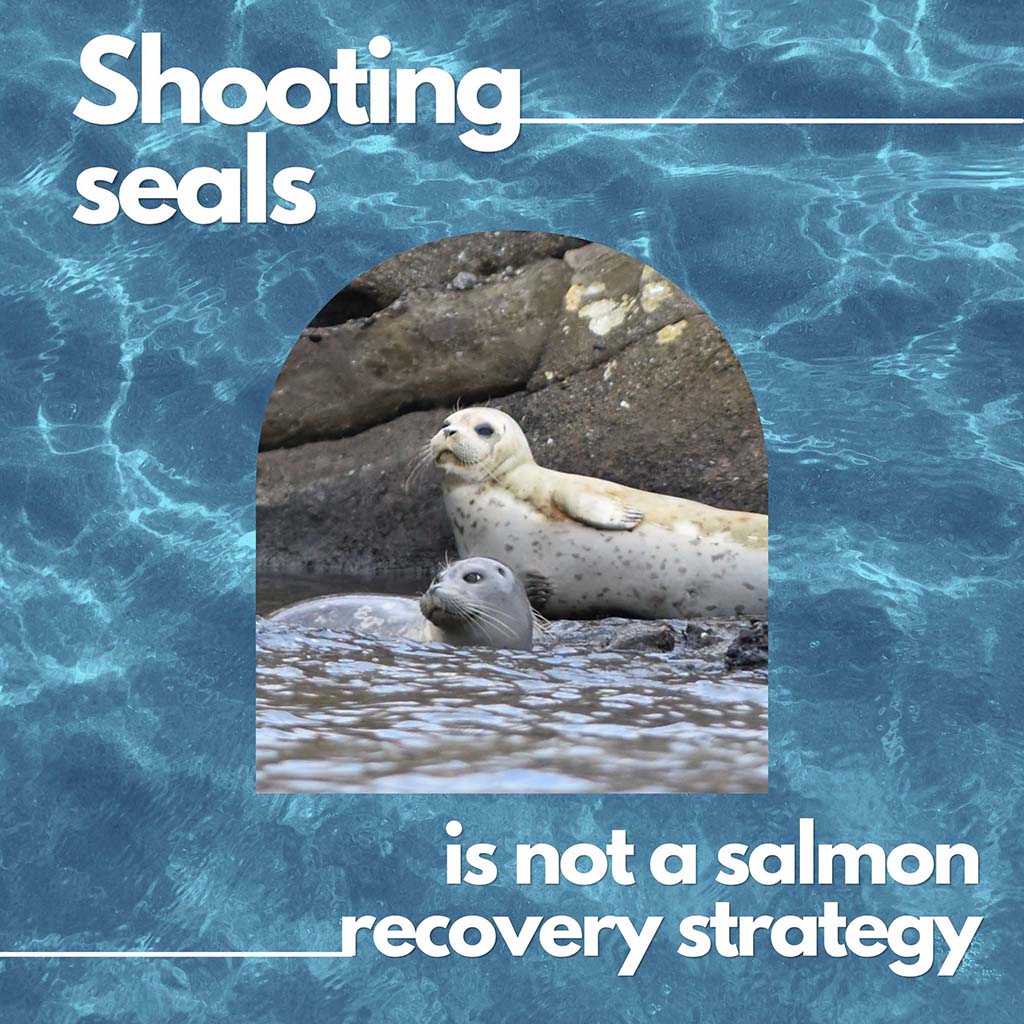
Earlier this month, Washington State Representative Michael Baumgartner introduced H.R. 9621, the so-called “Northwest Endangered Salmon Predation Prevention Act of 2026”. This bill, heard this week by the House Natural Resources Subcommittee on Water, Wildlife, and Fisheries, is the latest attempt to gain authorization to cull seals and sea lions in the name of recovering salmon stocks.
This bill would:
‣ Amend the Marine Mammal Protection Act to expand the lethal removal of pinnipeds from the Columbia River Basin to include all of Washington’s coastal and inland waters
‣ Expand lethal removal from Steller sea lions to also encompass California sea lions and harbor seals
‣ Strip the requirement for lethal take to be humane and conducted by state or tribal employees, opening the door for indiscriminate shooting with no oversight
We strongly oppose this legislation as a misguided effort that is not supported by science. We don’t have accurate estimates of how many pinnipeds there are in Washington State, and recent studies have shown we also don’t have reliable takes on the diet composition of seals and sea lions who are generalist predators. Animals removed from choke points will be replaced, and past examples show that widespread culls will have unintended ecosystem consequences. Additionally, this bill would not put into place any oversight or monitoring to determine the effectiveness of these lethal removals.
So what can you do? In Washington State, please let Governor Bob Ferguson and the Washington Department of Fish & Wildlife know about your opposition to this bill. WDFW testified in favor of this bill, despite their own biologists identifying significant knowledge gaps and untested assumptions relating to this topic. Additionally, if Representative Baumgartner or Representative Randall (the co-sponsor) are your federal representatives, it is definitely worth commenting to them as well.
The subcommittee currently hearing the bill has representatives from 11 states and territories. See if someone from your region is on the committee via the link below, and if so, please write to them as one of your elected officials: LINK HERE
This is another issue that will be a marathon and not a sprint. We will keep you updated on comment opportunities as they arise, but in the meantime you can learn more about this topic on the latest episode of the After the Breach Podcast where we were joined by SR³ - Sealife Response, Rehabilitation & Research executive director Casey McLean.