March 2026
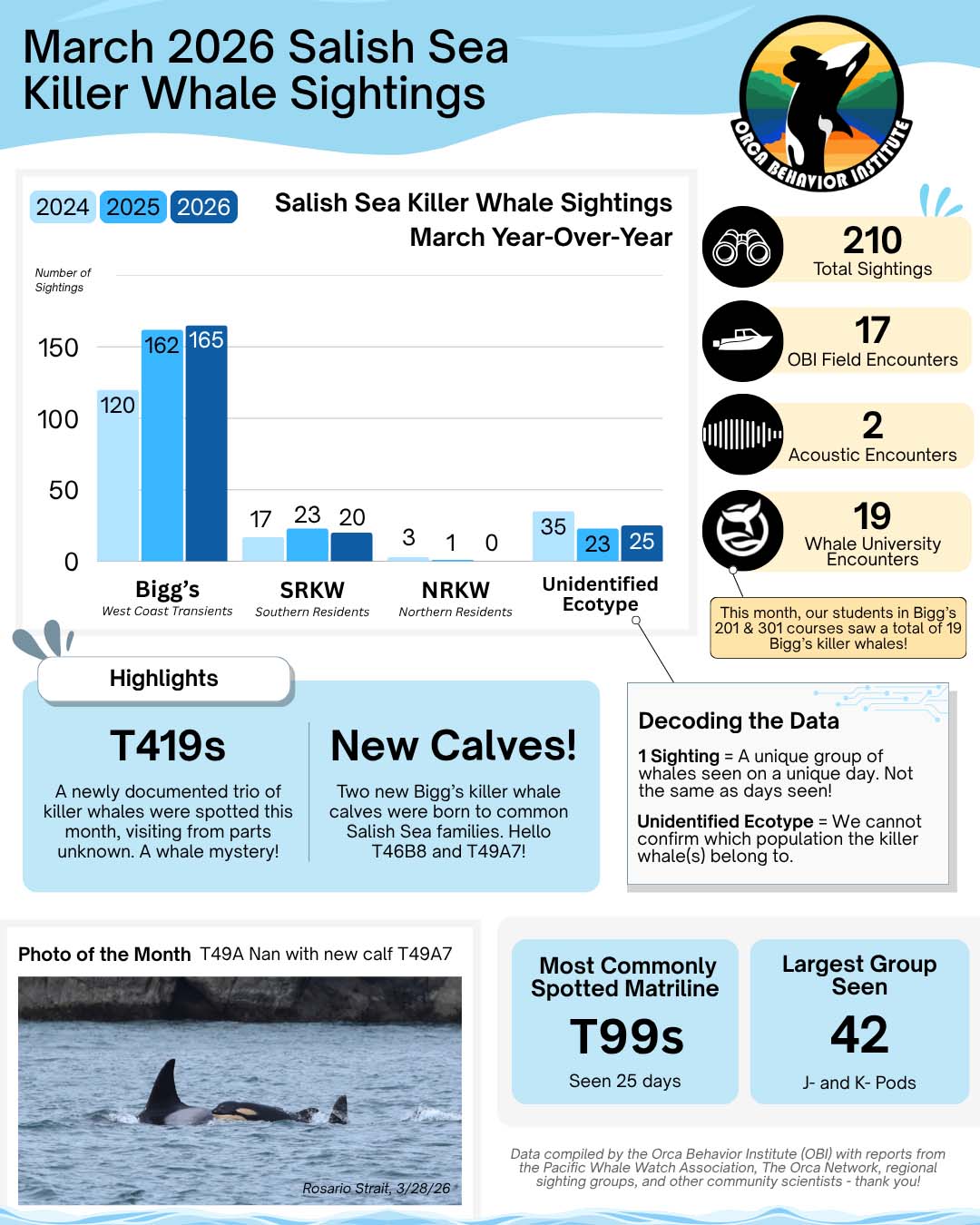
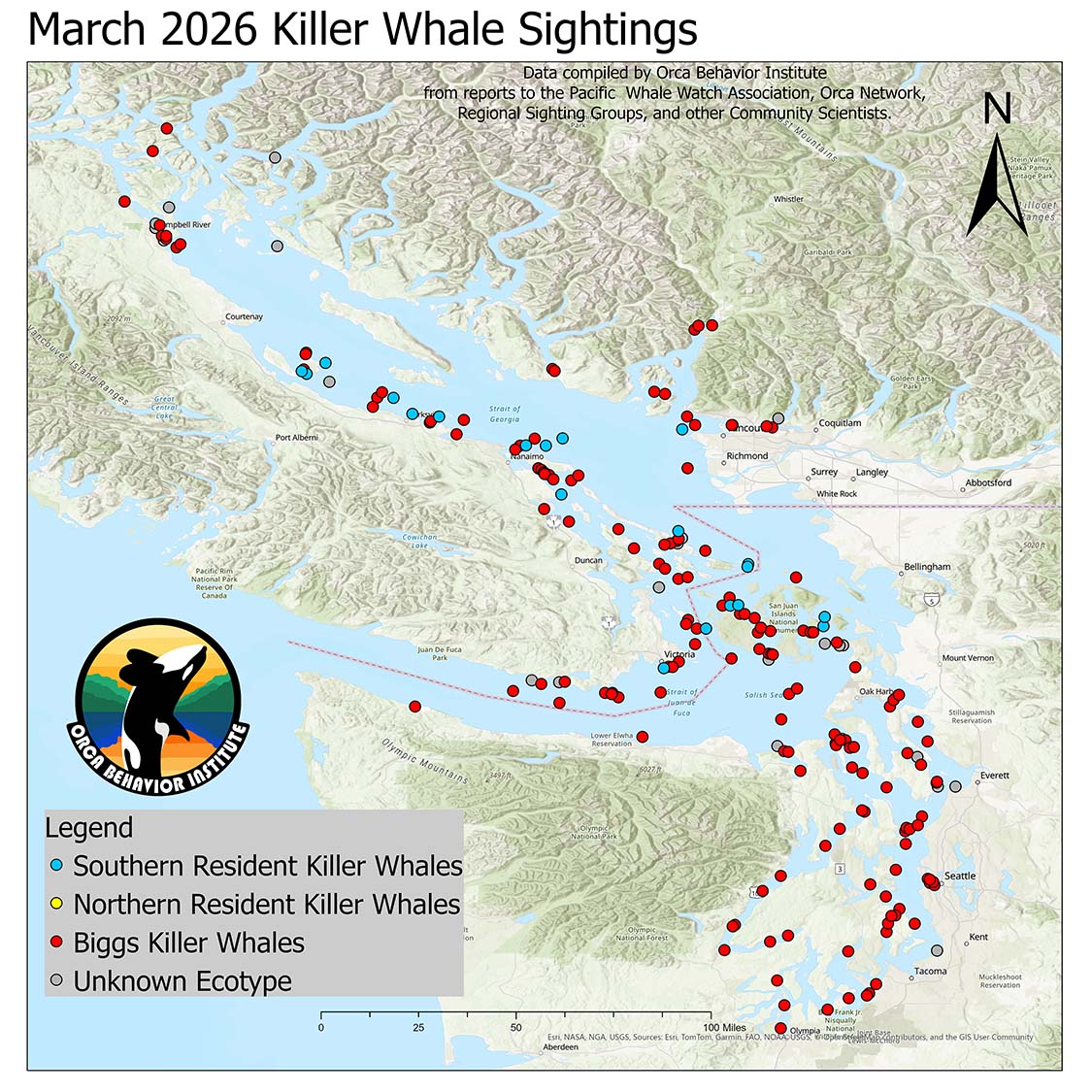
After a bit of a lull in January and Februry, the Bigg's killer whales marched back into the Salish Sea (pun intended) last month. We were able to help confirm their presence in the Salish Sea for all 31 days in the month of March with a record-setting 165 unique sightings. (We count a sighting as a unique group of animals seen on a unique day. The first known location of each unique sighting is shown on the map here.)
The whales were spread throughout the inland waters with regular reports occurring from Campbell River in the north to Olympia in the south and everywhere in between. Some highlights included two newly documented calves who have been designated T49A7 and T46B8 by Bay Cetology, the appearance of the mystery trio of killer whales now known as the T419s, and the first 2026 visits of many common Salish Sea matrilines including the T36As, T46Bs, T65As, T65Bs, and T124As. The dynamic duo of T87 Harbeson and T124C Cooper also spent the last week of the month cruising around the Salish Sea's central waters including visits to Vancouver and Howe Sound.
On March 28th, we had an incredible 13 different groups of Bigg's killer whales documented totaling over 50 individual orcas. We tend to have some chaotic days like that during the summer but I can't remember them ever occurring this early in the year! While it remains to be seen how the rest of 2026 will unfold, it's clear it will be another big year for Bigg's.
On the Southern Resident killer whale front, J-Pod returned to inland waters on March 1st. While we didn't have reports of them every day, we're fairly confident they stayed "in" for the entirety of the month, with 19 days of confirmed sightings. March has been a somewhat surprising peak month for SRKW presence over the last decade, and it was nice to see that trend continue this year as the Port of Vancouver's ECHO Program was doing a trial large ship slowdown in Haro Strait and Boundary Pass this March in response to a sightings report we helped compile for them a couple years ago. Usually their voluntary slowdowns occur in the summer and fall, coinciding with historic SRKW presence. As as the whales' patterns have shifted, adaptive management is necessary, and we applaud the Port for being willing to make adjustments to hopefully provide greater benefit to the whales. Slowing down large commercial shipping traffic quiets the waters, and the hope is the whales benefit by being better able to find food as result.
March through June are typically the months we have the lowest (or no) Northern Resident killer whale reports in the Salish Sea, so it wasn't unusual to have zero reports of that population last month. The unidentified killer whale reports, represented by the gray dots, indicate that orcas were confirmed but it was not possible to identify which ecotype.
Things have continued booming as the calendar has turned over into April, and we can't see how high the numbers rise this month!